
Acoustic Suspended Ceilings: The Importance of Acoustic Comfort in Offices, Education, and Hospitals
Acoustic Suspended Ceilings: The Importance of Acoustic Comfort in Offices, Education, and Hospitals
The design of modern buildings plays an important role not only in aesthetic appearance and functional design but also in sound comfort. The noise generated in offices, schools, universities, and hospitals directly affects people's daily activities, attention, and comfort.
In solving these problems, acoustic suspended ceiling systems are of significant importance. Specially designed acoustic ceiling panels reduce echo in the room, help sound to be heard more clearly, and create a more comfortable environment.
As Aspen Pro, we offer various Suspended ceiling systems, Stone wool-based panels, and acoustic solutions for modern construction and interior projects.
What is an acoustic suspended ceiling?
An acoustic suspended ceiling is a ceiling system created below the main ceiling using a special metal frame and sound-absorbing panels. Unlike ordinary decorative ceilings, acoustic ceiling panels have the ability to absorb a portion of sound waves.
These panels help reduce sound reflection from hard surfaces in the room and long-lasting echo.
The main advantages of acoustic suspended ceilings include:
- Reduction of echo and noise in the room;
- Improvement of clarity in conversation and communication;
- Increased acoustic comfort in work and educational environments;
- Compatibility with various lighting systems;
- Concealment of ventilation and other engineering communications;
- Facilitation of maintenance and panel replacement.
These features make acoustic suspended ceiling systems an essential solution for modern offices and public buildings.
The role of acoustic suspended ceilings in offices
In modern offices, open planning, Partition wall systems, hard granite coverings, and dropped ceilings are widely used. While this design approach makes the space appear larger and brighter, it can increase sound reflection.
Especially in open offices, phone calls, conversations among employees, meetings, and sounds created by technical equipment raise the overall noise level.
Acoustic suspended ceiling panels help mitigate this problem. Thanks to sound-absorbing panels:
- Sounds that distract employees' attention are reduced;
- Phone calls and meetings are conducted more comfortably;
- Clarity of speech is increased in conference and meeting rooms;
- A more comfortable work environment is created in call centers and open offices.
Especially in large offices, acoustic ceiling panels made of stone wool and mineral fiber with high sound absorption coefficients are effective choices.
The importance of acoustic ceiling systems in schools and universities
Sound comfort is one of the important factors affecting the quality of the teaching process in educational institutions.
In classrooms, auditoriums, and lecture halls, it is essential for the teacher's voice to be clearly heard by all participants. Long echo and high background noise can hinder students' and learners' ability to absorb information.
Acoustic suspended ceiling systems:
- Facilitate clear communication between teachers and students;
- Reduce echo in classrooms;
- Improve speech intelligibility in auditoriums and lecture halls;
- Help create a quiet environment in libraries and individual study areas.
When selecting acoustic ceilings for school and university projects, in addition to sound absorption coefficients, fire safety, material quality, hygiene, and maintenance options should also be considered.
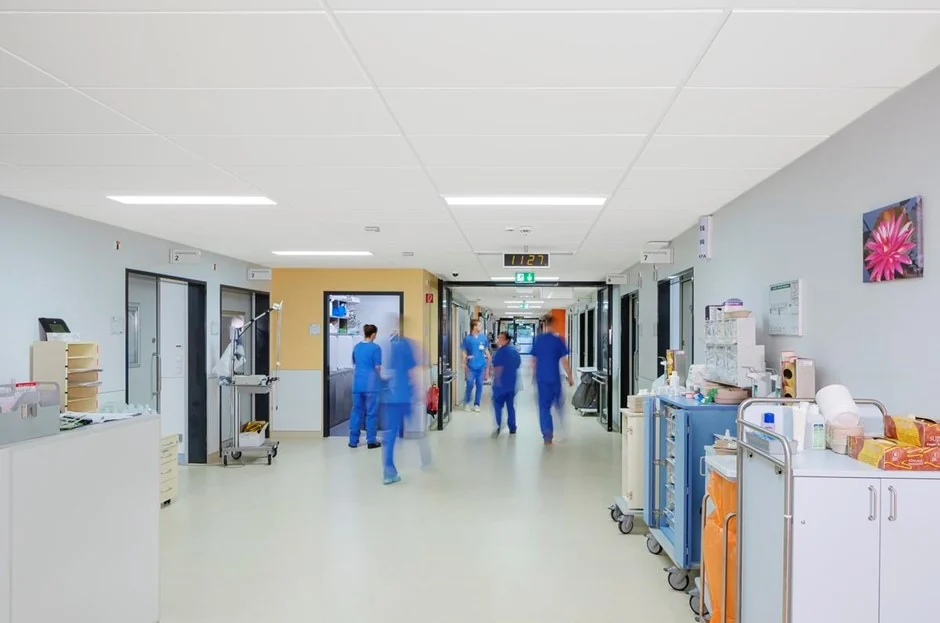
The role of acoustic suspended ceilings in hospitals
Hospitals and other healthcare facilities are places where sound comfort is of particular importance.
Noise arises from various sources in patient rooms, doctor's offices, waiting rooms, corridors, and examination rooms. Medical equipment, staff movement, and general communication sounds can affect patients' rest and the comfort of the space.
Well-chosen acoustic suspended ceiling systems:
- Increase sound comfort in patient rooms;
- Reduce overall noise in waiting rooms;
- Improve speech clarity in doctor's offices;
- Help create a more comfortable work environment for medical staff.
When selecting ceiling panels for hospitals, it is not enough to focus only on acoustic coefficients. Hygiene, washing and disinfection requirements, antibacterial properties, moisture resistance, fire safety, and the suitability of the materials used for healthcare environments should also be evaluated.
Therefore, it is essential to select panels with appropriate technical specifications for each hospital area.
Types of acoustic suspended ceiling panels
The choice of acoustic suspended ceiling systems depends on the purpose of the building, the technical requirements of the project, and the design concept.
1. Stone wool-based acoustic panels
Stone wool-based ceiling panels are distinguished by high sound absorption coefficients and various technical characteristics. They are used in offices, schools, hospitals, conference rooms, and other public spaces.
2. Mineral fiber-based suspended ceiling panels
Mineral fiber panels combine functionality, aesthetic appearance, and technical specifications. They can be adapted to different interior projects due to various surface and edge shapes.
3. Glass wool-based acoustic panels
Glass wool-based panels are used in modern offices and public spaces due to their sound absorption properties and lightweight construction. When selecting, the hygiene and fire specifications of the product should be checked.
4. Wood fiber acoustic panels
Wood fiber panels are chosen for their natural texture and aesthetic appearance. They can be used as acoustic and decorative solutions in auditoriums, restaurants, conference rooms, and other interiors.
What technical specifications should be considered when selecting an acoustic suspended ceiling?
When selecting an acoustic ceiling system, it is not correct to base the decision solely on the appearance and price of the panel. The technical specifications of the product should match the needs of the project.
- NRC (Noise Reduction Coefficient): This is a coefficient that indicates the sound absorption capability of the panel. As the value increases, the sound absorption performance of the panel improves.
- CAC (Ceiling Attenuation Class): This evaluates the resistance to sound transmission between adjacent rooms through the ceiling system.
- Fire safety: The fire class of the panel used must comply with the requirements of the project and local regulations.
- Moisture resistance: This is an important specification, especially in hospitals and other specialized facilities.
- Light reflectance: This affects the overall lighting level of the ceiling.
For the correct selection, the technical specifications of the panel and the test results of the manufacturer should be considered.
Note: Sound absorption and sound insulation are different concepts. NRC evaluates indoor sound absorption, while CAC evaluates resistance to sound transmission between rooms through the ceiling system.
Aspen Pro – Modern Suspended Ceiling and Acoustic Systems
Aspen Pro offers various suspended ceiling systems and acoustic solutions for modern offices, education, healthcare, and public buildings.
Our product range includes USG and OWA brand stone wool-based suspended ceiling panels, various metal ceiling systems, and wood fiber panel solutions.
We provide support for product selection, evaluation of technical specifications, and installation solutions according to the characteristics of the project.
The main solutions we offer include:
- Stone wool-based acoustic suspended ceilings;
- Mineral fiber ceiling panels;
- Metal suspended ceiling systems;
- Acoustic panel and ceiling solutions;
- Various T24 and T15, HookOn, and other suspension systems;
- Wood fiber panel systems.
When selecting products, the function of the facility, acoustic requirements, fire safety, and operational characteristics are taken into account.
To learn more about our products, visit the Suspended ceiling systems section.
Information about acoustic materials and other noise control solutions can be found in the Acoustic solutions section.
Conclusion
Acoustic suspended ceilings are not only decorative elements in modern construction and interior projects but also important engineering solutions that determine the functional quality of the space.
Choosing the right acoustic ceiling systems is essential for increasing productivity and communication comfort in offices, creating a clearer teaching environment in schools and universities, and ensuring sound comfort for patients and staff in hospitals.
As Aspen Pro, we offer modern suspended ceiling systems, acoustic panels, and technical solutions for your projects.
Contact Aspen Pro to select the appropriate acoustic suspended ceiling system for your project and to obtain detailed information.
Frequently Asked Questions (FAQ)
Why is acoustic suspended ceiling used?
Acoustic suspended ceilings are used to reduce echo and noise in the room, and to increase speech clarity and overall acoustic comfort.
What advantages do acoustic suspended ceilings create in offices?
In offices, acoustic ceiling panels help reduce echo during phone calls, meetings, and communication among employees.
Is acoustic ceiling important in schools and universities?
Yes. Acoustic ceiling systems help improve speech intelligibility in classrooms and auditoriums and enhance the teaching environment.
What ceiling panels are suitable for hospitals?
Panels used in hospitals must meet acoustic coefficients as well as hygiene, disinfection, moisture, and fire safety requirements.
What does the NRC coefficient mean?
NRC is a coefficient that indicates the sound absorption capability of the panel. As the NRC value increases, the sound absorption performance of the panel improves.